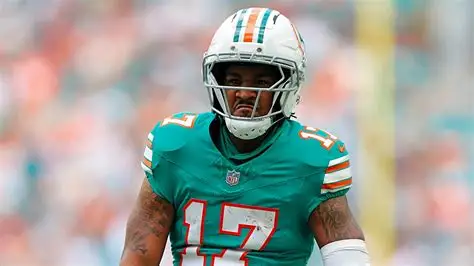
Jaylen Waddle Traded to Broncos: Elite Speedster Finds New Upside
The NFL landscape shifted on March 17, 2026. Jaylen Waddle, one of the league’s most explosive playmakers, found a new home. The Denver Broncos acquired the former Alabama star from the Miami Dolphins in a blockbuster trade that sends Waddle from South Beach to the Mile High City. This isn’t just a change of scenery—it’s an opportunity for reinvention, for a player with elite speed and proven production to reach his ceiling in an offense built to maximize his gifts.
The upside of this trade extends far beyond the transaction itself. Waddle arrives in Denver with something to prove, a contract that demands performance, and a coaching staff renowned for offensive innovation. At 27 years old, he enters the theoretical prime of his career with the leverage to shape his legacy rather than simply fulfill it.
The Trade That Changes Everything
Denver paid a premium to acquire Waddle. The Broncos sent first- and third-round picks to Miami, swapped fourth-round selections, and absorbed a contract that pays Waddle $6.8 million in 2026 and $24 million in 2027. This is not a flyer on potential. It is an investment in proven excellence.
The financial structure reveals Denver’s confidence. Waddle’s contract, originally a three-year, $84.75 million extension signed with Miami in 2024, becomes team-friendly for the Broncos. Miami already paid significant bonuses in 2024 and 2025. The Dolphins are reportedly covering $10.4 million of the remaining guarantees, making Waddle’s effective cost even more reasonable for a receiver of his caliber.
The upside is clear. Denver acquires a 27-year-old receiver with 366 career receptions for 4,941 yards and 26 touchdowns. A player who averaged 18.1 yards per catch in 2022. A former first-round pick who has already demonstrated he can be a primary weapon. At a price point that looks like a bargain compared to recent receiver contracts—DJ Moore will make $24.5 million annually in Buffalo, Wan’Dale Robinson received $38 million over two years in Tennessee—Waddle represents value with elite upside.
The Alabama Foundation of Excellence
Waddle’s pedigree is impeccable. At Alabama, he totaled 1,965 receiving yards and 17 touchdowns on 103 receptions across three seasons. He owns three of the top-five longest scoring receptions in Crimson Tide history. He led the nation in punt return average at 24.4 yards per return in 2019, shattering Alabama’s single-season record.
The upside of this collegiate dominance was NFL readiness. Drafted sixth overall by Miami in 2021, Waddle immediately validated the investment. His rookie season produced 104 catches for 1,015 yards and 6 touchdowns—franchise records that announced his arrival. The speed that made him a national champion and first-round pick translated instantly to professional football.
His 2022 season demonstrated ceiling. Seventy-five receptions for 1,356 yards and 8 touchdowns. An 18.1 yards per catch average that led the league. A 57-yard reception that showcased his ability to take the top off defenses. This wasn’t just production—it was dominance that established Waddle among the NFL’s elite deep threats.
The Miami Years: Upside and Frustration
Waddle’s tenure in Miami produced highlights and complications. He formed one of the league’s most dangerous receiving duos with Tyreek Hill. The “Cheetah” and the speedster created matchup nightmares for defensive coordinators. Yet the Dolphins’ offensive inconsistency, quarterback changes, and scheme limitations prevented Waddle from reaching his full potential.
The 2024 season was particularly frustrating. Hampered by a late-season knee injury, Waddle managed just 58 catches for 744 yards and 2 touchdowns—career lows that belied his talent. The 2025 season showed recovery: 64 receptions for 910 yards and 6 touchdowns in 16 games. Solid production, but not the dominance he demonstrated in 2022.
The upside of the trade is escape from limitation. In Miami, Waddle competed for targets with Hill and an emerging running game. In Denver, he arrives as the primary weapon, the receiver around whom Sean Payton will build his passing attack. The change of quarterback—from Tua Tagovailoa to Bo Nix—offers fresh chemistry and new opportunity.
The Sean Payton Advantage
Sean Payton’s offensive mind is legendary. His New Orleans Saints consistently produced elite receiver numbers through scheme innovation and matchup exploitation. In Denver, Payton has sought a true No. 1 receiver to anchor his attack. Waddle provides exactly that.
The upside of this pairing is schematic. Payton’s offense emphasizes vertical threats that stretch defenses and create space for intermediate routes. Waddle’s 4.37-second 40-yard dash speed makes him the perfect weapon for this approach. Defenses must account for his deep ability, opening opportunities for tight ends and slot receivers underneath.
Payton’s history with elite receivers—Michael Thomas in New Orleans, various weapons throughout his Saints tenure—suggests he will maximize Waddle’s talents. The Broncos’ offensive line, improved through recent investments, can provide the time for deep routes to develop. The running game, featuring Javonte Williams and Samaje Perine, can force defenses to commit resources to the box, leaving single coverage for Waddle to exploit.
The Bo Nix Connection
Bo Nix enters his second season as Denver’s starter with a weapon he has never had. Nix showed promise in 2025, demonstrating accuracy and decision-making that suggest he can be a franchise quarterback. Adding Waddle accelerates his development exponentially.
The upside for Nix is a true No. 1 receiver who demands defensive attention. Waddle’s ability to win deep routes provides a safety valve when plays break down. His speed after the catch turns short passes into long gains. His presence on the field changes how defenses approach the Broncos, creating opportunities for other receivers and the running game.
Nix and Waddle will develop chemistry through offseason work and training camp. The timing routes that Waddle ran with Tagovailoa at Alabama and Miami can be replicated in Denver’s offense. The deep shots that stretch defenses will become staples of the Broncos’ attack. This partnership has the potential to define both careers.
The 2026 Season: Unlimited Potential
Waddle arrives in Denver with immediate opportunity. The Broncos’ receiving corps, while solid, lacks a true game-breaker. Courtland Sutton provides reliable possession skills. Tim Patrick offers size and contested-catch ability. But neither possesses Waddle’s speed or big-play potential.
The upside is target share. Waddle can expect 120-plus targets in Payton’s offense, a significant increase from his 2025 usage. With those targets, his production could return to 2022 levels—1,300-plus yards and double-digit touchdowns. The efficiency that marked his early career—career averages of 13.5 yards per catch and 66% catch rate—suggests he will maximize every opportunity.
Fantasy football managers should take notice. Waddle’s ADP will rise significantly with this move. He moves from a crowded Miami offense to a Denver attack built around his strengths. The red zone opportunities, the deep targets, the overall volume all point to a career year.
The Contract Motivation
Waddle’s contract structure provides personal incentive. His 2027 salary of $24 million becomes guaranteed if he remains on the roster beyond the 2026 season. This means 2026 is effectively a contract year, even with guaranteed money remaining. Waddle must produce to secure long-term security and future earnings.
The upside of this pressure is performance. Players in contract years often deliver their best seasons. Waddle, with his elite speed and proven production, has every tool to exceed expectations. The motivation of proving himself in a new city, with a new quarterback, in a new offense, should drive elite preparation and execution.
The Mile High Effect
Denver’s altitude provides unique advantages for speed receivers. The thin air allows footballs to travel farther, making deep routes more viable. Defenses tire more quickly, creating separation late in games. Waddle’s speed, already elite at sea level, becomes even more devastating at 5,280 feet.
The upside is home-field advantage. Opponents visiting Denver must adjust to conditions that Waddle will master through practice and repetition. The deep routes that are difficult to defend at sea level become nearly impossible at altitude. The Broncos’ home games will showcase Waddle’s speed in ways that Miami’s neutral-site atmosphere never could.
The AFC West Battleground
The AFC West is the NFL’s most competitive division. Patrick Mahomes and the Kansas City Chiefs remain the standard. Justin Herbert and the Los Angeles Chargers continue to build. The Las Vegas Raiders seek resurgence. Waddle’s arrival elevates the Broncos into this conversation.
The upside is competitive relevance. Denver has sought a receiver who can match the division’s firepower. Waddle provides that capability. His speed creates problems for division rivals who must now account for another elite weapon. The Broncos’ offense, long a limitation, becomes a strength with Waddle’s addition.
The Long-Term Vision
Waddle’s trade to Denver isn’t just about 2026. It’s about building a foundation for sustained success. At 27, he can anchor the Broncos’ receiving corps for the next five years. His contract, structured through 2028, provides continuity that allows for long-term planning.
The upside is organizational stability. Denver has lacked a true No. 1 receiver since Demaryius Thomas’s prime. Waddle fills that void. He provides a target for Nix’s development, a weapon for Payton’s scheme, and a star for the franchise’s marketing. The trade transforms the Broncos’ offensive identity from the ground up.
Conclusion: The Upside of Reinvention
Jaylen Waddle’s trade to the Denver Broncos represents more than a transaction. It is an opportunity for a player with elite speed and proven production to reach his ceiling in an environment designed to maximize his gifts. The Sean Payton offense, the Bo Nix connection, the Mile High altitude, and the AFC West competition all point to a career-defining season.