Canada Elections: A Comprehensive Overview of the 2021 and 2025 Outcomes
Canada elections are pivotal events that shape the nation’s political landscape. The elections held in 2021 and 2025 were particularly significant, reflecting shifts in public sentiment, party dynamics, and leadership transitions. This article delves into the details of these elections, examining the parties involved, the outcomes, and the implications for Canada’s governance.
The 2021 Federal Election: Continuity Amidst Challenges
Canada Election Overview
On September 20, 2021, Canada conducted its 44th federal election to elect members to the House of Commons. This election was called early by Prime Minister Justin Trudeau, aiming to secure a majority government amidst the COVID-19 pandemic. However, the results mirrored the 2019 election, leading to another minority government.
Canada Elections: Major Political Parties and Results
- Liberal Party of Canada
- Leader: Justin Trudeau
- Seats Won: 160
- Popular Vote: 32.6%
- Despite winning the most seats, the Liberals fell short of the 170 needed for a majority, resulting in a minority government.
- Conservative Party of Canada
- Leader: Erin O’Toole
- Seats Won: 119
- Popular Vote: 33.7%
- The Conservatives secured the highest percentage of the popular vote but won fewer seats, continuing as the Official Opposition.
- Bloc Québécois
- Leader: Yves-François Blanchet
- Seats Won: 32
- Popular Vote: 7.6%
- The Bloc maintained its position as a significant force in Quebec politics.
- New Democratic Party (NDP)
- Leader: Jagmeet Singh
- Seats Won: 25
- Popular Vote: 17.8%
- The NDP made modest gains but did not achieve a significant breakthrough.
- Green Party of Canada
- Leader: Annamie Paul
- Seats Won: 2
- Popular Vote: 2.3%
- The Green Party’s support declined, and its leader failed to win her seat.
- People’s Party of Canada (PPC)
- Leader: Maxime Bernier
- Seats Won: 0
- Popular Vote: 4.9%
- Despite increasing its popular vote share, the PPC did not secure any seats.
Post-Election Developments
Following the election, the Liberals formed a minority government. In March 2022, they entered into a confidence-and-supply agreement with the NDP, ensuring support on key votes. This agreement lasted until September 2024, when the NDP withdrew, citing the achievement of their objectives.
Transition in Leadership: From Trudeau to Carney
In early 2025, Justin Trudeau stepped down as the leader of the Liberal Party, and Mark Carney, former Governor of the Bank of Canada and the Bank of England, succeeded him. Carney’s entry into politics marked a significant shift, bringing his economic expertise to the forefront of Canadian politics.
The 2025 Federal Canada Election: A New Chapter
Canada Election Context
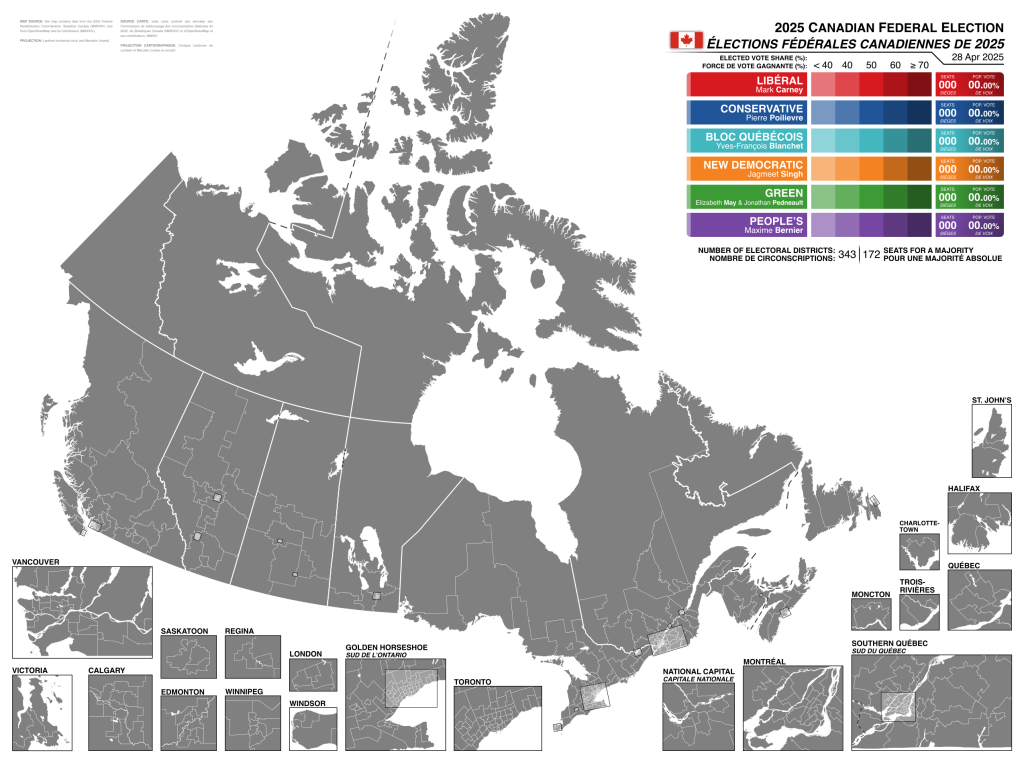
The federal election held on April 28, 2025, was marked by heightened political engagement, driven by economic concerns and international tensions, particularly with the United States. Approximately 28 million Canadians were registered to vote across 343 ridings, an increase from 338 in 2021.
Election Results
- Liberal Party of Canada
- Leader: Mark Carney
- Projected Seats: Approximately 157-160
- The Liberals won the most seats but fell short of a majority, necessitating coalition talks or forming a minority government.
- Conservative Party of Canada
- Leader: Pierre Poilievre
- The Conservatives faced challenges in distancing themselves from U.S. political influences, which affected their performance.
- Bloc Québécois
- Leader: Yves-François Blanchet
- Seats Won: Approximately 23
- The Bloc’s performance positioned them as potential kingmakers in the new Parliament.
- New Democratic Party (NDP)
- Leader: Jagmeet Singh (resigned post-election)
- The NDP suffered significant losses, leading to Singh’s resignation.
Key Factors Influencing the Outcome
- Economic Concerns: Voters were influenced by issues such as the cost of living and housing affordability.
- International Relations: Tensions with the U.S., particularly rhetoric from President Trump, impacted voter sentiment.
- Leadership Transition: Carney’s reputation for economic stewardship appealed to voters seeking stability.
Implications and Future Outlook
The 2025 election results indicate a continued preference among Canadians for centrist policies and economic stability. The Liberals, under Carney’s leadership, are expected to focus on:
- Economic Management: Addressing inflation and promoting growth.
- International Relations: Repairing and strengthening ties with global partners.
- Domestic Policies: Tackling housing affordability and healthcare improvements.
Collaboration and compromise will be necessary to build coalitions or operate as a minority government, shaping the legislative agenda in the coming years.
Conclusion
The Federal Canada elections in 2021 and 2025 underscore the dynamic nature of its political landscape. The transition from Trudeau to Carney marks a new era, with economic expertise at the helm. As the nation navigates domestic challenges and international complexities, the government’s ability to foster unity and implement effective policies will be crucial for Canada’s continued prosperity.