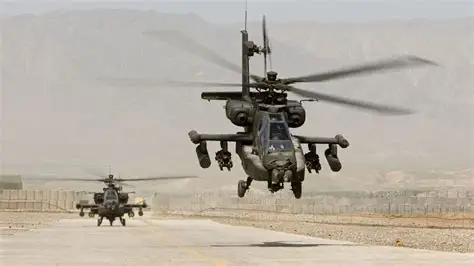
An attack helicopter represents one of the most recognizable forms of modern military aviation. Built to operate close to the battlefield, these specialized aircraft combine mobility, advanced sensors, communications, protection, and weapons systems in a single platform.
Unlike conventional transport helicopters, an attack helicopter is designed primarily for combat support and armed missions. Modern examples can support ground forces, conduct armed reconnaissance, engage armored vehicles, provide escort and force protection, and operate alongside other aircraft and unmanned systems. The Joint Air Power Competence Centre describes attack helicopters as important assets for close air support, anti-tank operations, reconnaissance support, and protection of other helicopters.
The technology behind these aircraft has evolved dramatically.
Today’s platforms are not simply helicopters carrying weapons. They are highly connected airborne systems designed to gather information, share it with other forces, operate in challenging conditions, and provide commanders with additional options.
The positive story surrounding the attack helicopter is therefore much larger than firepower. It is a story of engineering, aviation, teamwork, innovation, training, and continuous technological development.
What Is an Attack Helicopter?
An attack helicopter is a military rotorcraft specifically designed to perform armed missions against battlefield targets and support friendly forces.
These aircraft generally emphasize:
- Mobility
- Situational awareness
- Precision
- Survivability
- Communication
- Battlefield coordination
- Mission flexibility
The U.S. Army describes the AH-64E Apache as a twin-engine, four-blade, tandem-seat aircraft capable of armed reconnaissance, close combat, mobile strike, and vertical maneuver missions.
This combination makes the attack helicopter a unique military platform.
It can operate from relatively confined locations, maneuver around terrain, and remain closely connected to ground forces.
The Evolution of Attack Helicopters
The modern attack helicopter developed from decades of military aviation experimentation.
Earlier helicopters demonstrated that rotary-wing aircraft could provide capabilities unavailable to conventional fixed-wing aircraft.
The Bell AH-1 Cobra became an important milestone in the development of the modern dedicated attack-helicopter concept. It introduced the familiar tandem seating arrangement and narrow fuselage associated with many later attack helicopters.
The technology continued to evolve.
Aircraft became faster, more heavily protected, more capable at night, and increasingly dependent on sophisticated sensors and communications.
The AH-64 Apache became one of the most prominent examples of this evolution.
The U.S. Army began receiving the Apache in 1984, and the platform has undergone continuous modernization since then.
The Apache: An Icon of Military Aviation
Among modern attack helicopters, the AH-64 Apache has achieved extraordinary recognition.
The U.S. Army describes the Apache as its heavy attack helicopter, while Boeing says the aircraft has accumulated more than 5.3 million flight hours and has been adopted by numerous countries.
The Apache’s long service history demonstrates an important principle in military aviation: successful aircraft do not remain successful simply because of their original design.
They must evolve.
New sensors, communications equipment, software, defensive systems, navigation technologies, and weapons integration have repeatedly transformed the platform.
The result is an aircraft that shares the name of its original design while possessing capabilities far beyond the earliest versions.
The AH-64E Apache
The AH-64E represents a major evolution of the Apache family.
The U.S. Army identifies the AH-64E as the current evolution of the platform, with an open systems architecture intended to make future technology integration easier.
Boeing lists the aircraft with a two-person crew, a maximum operating weight of 23,000 pounds, and a maximum level-flight speed of more than 150 knots.
The aircraft’s capabilities are built around an integrated combination of aviation and digital technologies.
This includes sensors, communications, navigation, targeting systems, and weapons.
That integration is one of the major strengths of modern military aircraft.
The Importance of Sensors
Modern warfare increasingly depends on information.
An attack helicopter must understand its surroundings, identify potential threats, communicate with friendly forces, and support decisions under difficult conditions.
Advanced sensors therefore play a central role.
The British Army says its AH-64E Apache combines Longbow radar with optical and thermal imaging systems to support target detection and operations in low-visibility conditions.
These technologies provide crews with information that would be difficult or impossible to obtain using unaided vision.
The development of sensors has consequently transformed the role of the attack helicopter from a relatively simple armed aircraft into an advanced information platform.
Night and All-Weather Capability
One of the defining strengths of modern attack helicopters is their ability to operate in difficult environmental conditions.
Night vision and thermal imaging can help crews operate when ordinary visibility is limited.
The British Army notes that the AH-64E is designed to operate during day and night and in different weather conditions.
This capability expands operational flexibility.
Instead of depending entirely on daylight and clear weather, modern crews can use specialized systems to maintain situational awareness across a much wider range of conditions.
Weapons and Mission Flexibility
Attack helicopters are designed around mission flexibility.
Modern platforms can carry combinations of cannon ammunition, rockets, and guided missiles depending on mission requirements.
The U.S. Army lists the Apache’s M230 30mm cannon, Hydra 70 rockets, and Hellfire missiles among its weapons systems.
The purpose of this flexibility is not simply to increase destructive power.
Different weapons provide different capabilities.
The aircraft can therefore be configured to support different operational requirements.
This allows commanders to use the platform as part of a broader combined-arms force.
Supporting Ground Forces
One of the most important roles of an attack helicopter is supporting soldiers operating on the ground.
Ground forces can encounter obstacles involving terrain, armored vehicles, fortified positions, and other battlefield threats.
An attack helicopter can provide an aerial perspective and rapidly move between areas where support is required.
The Joint Air Power Competence Centre identifies close air support as one of the central missions of attack helicopters.
This ability to connect air power with ground maneuver remains one of the strongest arguments for maintaining specialized rotary-wing capabilities.
Anti-Armor Operations
Attack helicopters were heavily influenced by the need to counter armored formations.
Their ability to carry guided anti-tank weapons made them valuable against armored vehicles.
The U.S. Army identifies the Apache’s ability to engage armor, personnel, and materiel targets as a central part of its mission.
This capability gives commanders another tool for dealing with armored threats.
Modern aircraft can also use advanced sensors to improve the process of finding and identifying targets.
Reconnaissance and Armed Observation
Attack helicopters can also contribute to reconnaissance.
Their ability to fly at different altitudes and operate close to ground formations allows them to support battlefield observation.
The British Army lists Intelligence, Surveillance, Target Acquisition and Reconnaissance among the Apache’s capabilities.
This reflects the broader transformation of military aviation.
An aircraft does not need to destroy a target to have an important battlefield effect.
Information itself can be powerful.
Accurate information can help commanders understand changing situations and coordinate resources more effectively.
Protecting Other Aircraft
Attack helicopters can also serve as escorts for other helicopters.
Transport aircraft carrying personnel or supplies may require protection when operating in contested environments.
The Joint Air Power Competence Centre identifies escort and protection of other helicopter missions as another role for attack helicopters.
This demonstrates why these aircraft are often considered part of a larger aviation ecosystem rather than independent platforms.
Their value increases when they operate alongside reconnaissance aircraft, transport helicopters, drones, ground forces, and other systems.
The Rise of Manned-Unmanned Teaming
One of the most exciting developments in attack-helicopter technology is the integration of crewed aircraft with unmanned systems.
The concept is commonly referred to as manned-unmanned teaming.
The idea is straightforward: crewed aircraft and unmanned systems can work together to extend awareness and operational flexibility.
The U.S. Army has described the AH-64E as having capabilities for manned-unmanned teaming, including the ability to interact with unmanned aircraft systems.
Boeing is also developing future Apache capabilities involving autonomous systems and launched effects.
This could become one of the most important areas of development for attack helicopters.
Attack Helicopters in the Age of Drones
The rise of inexpensive drones has changed military aviation.
Small unmanned aircraft can provide surveillance, carry payloads, and create new threats to larger platforms.
Recent military exercises increasingly include counter-drone measures and tactics designed to protect helicopters from unmanned threats. A 2026 Taiwan exercise, for example, integrated Apache and Black Hawk helicopters with counter-drone capabilities.
This does not necessarily mean attack helicopters are becoming obsolete.
Instead, it means their operating environment is changing.
Future attack helicopters are likely to depend increasingly on networking, electronic protection, unmanned teammates, improved sensors, and more adaptable tactics.
Survivability Remains Essential
An attack helicopter operates in a dangerous environment.
Modern battlefields can contain a wide range of threats, including small arms, anti-aircraft systems, guided missiles, drones, and electronic warfare.
Military aviation therefore places enormous emphasis on survivability.
Survivability can involve:
- Armor and structural protection
- Warning systems
- Defensive aids
- Electronic protection
- Terrain masking
- Crew training
- Tactical flexibility
- Redundant systems
The U.S. Army’s modern Apache includes upgraded survivability and situational-awareness technologies.
The objective is to help crews recognize threats and operate as effectively as possible in complex environments.
The Human Element
Technology may dominate discussions about attack helicopters, but people remain at the center.
A modern attack helicopter depends on highly trained pilots, aircrew, maintainers, engineers, intelligence specialists, commanders, and ground personnel.
Every mission requires preparation.
Aircraft must be inspected.
Systems must be tested.
Crews must train.
Information must be analyzed.
Maintenance teams must keep sophisticated equipment operational.
This human network is one of the most important factors behind military aviation capability.
Training and Safety
High-performance aircraft require exceptional training.
Crews must understand aviation fundamentals, aircraft systems, navigation, communications, emergency procedures, and mission coordination.
Safety is particularly important because helicopters operate in complex environments and often conduct demanding training missions.
In August 2026, the U.S. Army temporarily paused Apache training missions following a fatal crash near Fort Hood before resuming training after a safety and operational review.
The incident highlights the risks involved in military aviation and the importance of continuous safety improvement.
Training is not simply preparation for combat.
It is also preparation to bring crews home safely.
International Growth of Apache Capability
The Apache has become an international platform.
Boeing lists countries including Australia, India, Japan, South Korea, the United Kingdom, the Netherlands, Saudi Arabia, and others among its operators or customers.
Australia’s transition to the AH-64E is a recent example.
Australian Army Apache helicopters began flying operations in Townsville in late 2025, marking an important step in the country’s development of an attack-helicopter capability.
In July 2026, Australia conducted its first live firing of AH-64E Apaches on Australian soil during Exercise Possum Guns.
These developments show how countries continue investing in advanced rotary-wing aviation.
Attack Helicopters and Technological Modernization
Military aircraft have increasingly become software-driven systems.
Modernization can involve more than replacing engines or weapons.
It can include:
- New computing systems
- Digital communications
- Improved sensors
- Advanced navigation
- Open architectures
- Better data links
- Autonomous-system integration
- Electronic protection
The open architecture of the AH-64E is particularly important because it provides a pathway for future technologies.
This approach can help extend an aircraft’s useful life while allowing new capabilities to be introduced over time.
The Future of Attack Helicopters
The future of the attack helicopter will likely be defined by connectivity.
Rather than operating as isolated aircraft, future helicopters are expected to function as parts of broader networks.
They may exchange information with:
- Drones
- Ground vehicles
- Other helicopters
- Fixed-wing aircraft
- Satellites
- Command centers
- Sensors
The Joint Air Power Competence Centre expects future rotary-wing forces to increasingly operate in multi-domain environments and potentially integrate unmanned systems through manned-unmanned teaming.
This evolution could make future helicopters more useful even as battlefield threats become more complicated.
The Positive Impact of Continued Innovation
The development of attack helicopters demonstrates how engineering responds to changing requirements.
When threats change, aircraft change.
When sensors improve, situational awareness improves.
When communications improve, coordination becomes stronger.
When unmanned systems mature, new possibilities emerge.
This constant cycle of innovation is one of the most fascinating aspects of aerospace technology.
The attack helicopter is therefore not a frozen concept from the past.
It is an evolving technology.
Beyond Firepower
It is easy to describe an attack helicopter only in terms of weapons.
That perspective misses much of what makes the platform technologically important.
An attack helicopter combines:
- Aerodynamics
- Materials engineering
- Propulsion
- Electronics
- Computing
- Communications
- Sensors
- Human-machine interaction
- Navigation
- Logistics
- Advanced manufacturing
Every flight represents the integration of thousands of technical decisions.
This makes military rotorcraft an important area of aerospace engineering and technological development.
The Economic and Industrial Impact
Advanced military helicopters also support large industrial ecosystems.
Their development and maintenance require engineers, technicians, manufacturers, software specialists, mechanics, researchers, and suppliers.
Aircraft production can stimulate work across multiple industries.
Modernization programs can also create long-term demand for advanced electronics, sensors, engines, communications systems, and materials.
This industrial base can contribute to broader aerospace expertise.
Attack Helicopter: A Symbol of Aviation Innovation
The visual image of an attack helicopter is powerful.
Its compact profile, rotating blades, advanced sensors, and specialized design immediately communicate that it is built for a very different purpose from civilian helicopters.
But the real story lies beneath the surface.
Modern attack helicopters are sophisticated systems that have evolved through decades of research, operational experience, engineering improvements, and technological innovation.
The AH-64 Apache’s history is a strong example.
From its first delivery in 1984 to today’s AH-64E, the platform has undergone continuous modernization.
Conclusion
The attack helicopter remains one of the most distinctive and technologically advanced platforms in military aviation.
Its value comes from more than speed or weapons.
It comes from mobility, sensors, communication, flexibility, survivability, and the ability to support larger military operations.
The AH-64 Apache demonstrates how a successful aircraft can continue evolving for decades. The U.S. Army has repeatedly modernized the platform, while allied countries continue adopting and developing their own Apache capabilities.
At the same time, the battlefield is changing rapidly.
Drones, electronic warfare, advanced sensors, artificial intelligence, and autonomous systems are creating new challenges and opportunities. The future attack helicopter will therefore need to be more connected, adaptable, and technologically sophisticated.
The positive outlook is clear: innovation is not stopping.
Future attack helicopters can become more intelligent, more integrated, and better connected with the wider force.
Their evolution also demonstrates something larger about aviation technology. The most successful aircraft are not necessarily those that remain unchanged. They are the ones capable of adapting.
From the early generations of attack helicopters to today’s advanced Apache platforms, military rotorcraft have continually transformed to meet new demands.
The attack helicopter is therefore not simply a symbol of military power.
It is also a remarkable example of how aerospace engineering continues to evolve.
Reference
For more technology, defense, aviation, business, and current-affairs articles, visit Daily Talks Web.