Braylon Mullins: Freshman Hero Sends UConn to Final Four
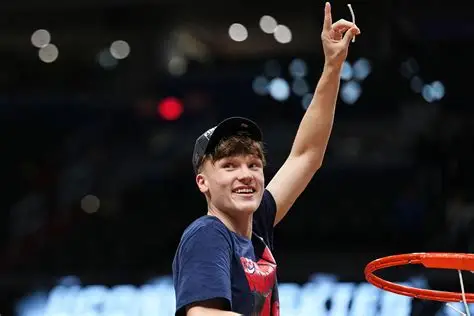
The shot hung in the air for an eternity. Thirty-five feet from the basket, 0.4 seconds on the clock, the season on the line. Braylon Mullins, UConn’s freshman guard who had missed his first four three-point attempts, who had shot 17.5% from deep since February, who had never faced a moment this big, launched anyway. The ball arced through the Washington D.C. arena, over the outstretched hands of Duke defenders, and swished through the net as the buzzer sounded. UConn 73, Duke 72. Pandemonium. History. A freshman’s introduction to March Madness immortality.
The upside of Mullins’ moment extends far beyond one victory. It reveals a 19-year-old with the clutch gene that cannot be taught. It demonstrates that pressure is a privilege he embraces. It suggests that UConn has found a superstar who will anchor their program for years to come. On March 29, 2026, Braylon Mullins didn’t just win a game—he announced his arrival as college basketball’s next great closer.
The Shot That Shocked March Madness
The context makes the shot miraculous. UConn trailed by as many as 19 points in the first half. They were down 15 at halftime, facing the largest deficit they had overcome all season. They had missed 17 of their first 18 three-point attempts. Mullins himself was 0-for-4 from deep, part of a shooting slump that had seen him hit just 10 of 57 three-pointers since February .
Yet when the ball came to him with the game tied and seconds ticking away, Mullins didn’t hesitate. After a deflected pass, senior Alex Karaban had the ball with five seconds left. He looked at the rim, saw Duke’s Cam Boozer defending, and made a split-second decision. “When I saw Braylon, and for some reason I had the gut instinct to pass it to him,” Karaban explained. “When I saw him release it, I was like, that really might go in” .
Mullins caught the pass 35 feet from the basket. Three seconds remained. One chance to save the season. “I knew I had to put one up,” Mullins said. The shot was pure. The celebration was immediate. “Just happy to see that s*** go in,” Mullins told CBS with a grin. “I’m so happy” .
The shot capped a historic comeback. UConn became the first No. 1 seed to lose in the NCAA tournament after leading by 15-plus points at halftime—such teams were previously 134-0 . It tied the sixth-largest comeback in NCAA tournament history. And it sent the Huskies to their third Final Four in four years, with Lucas Oil Stadium in Indianapolis waiting—just 26 miles from Mullins’ high school gym .
The Indiana Roots That Shaped a Shooter
Braylon Anthony Mullins was born April 18, 2006, in Greenfield, Indiana, a suburb 30 minutes east of Indianapolis. His father, Josh Mullins, played college basketball at Lincoln Trail College and IUPUI, passing basketball genes and work ethic to his son . At Greenfield-Central High School, Mullins became a legend.
The upside of this foundation is elite preparation. As a senior, Mullins averaged 32.9 points, 7.2 rebounds, 4.2 assists, and 3.7 steals per game while shooting 47.6% from three-point range . He scored 2,158 career points, becoming Greenfield-Central’s all-time leading scorer. He once dropped 51 points in a single game, then broke his own record with 52 points on February 23, 2025 .
The awards accumulated: 2025 McDonald’s All-American, Indiana’s Mr. Basketball (joining alumni like Eric Gordon, Greg Oden, and the Zeller brothers), Gatorade Indiana Player of the Year . He was a consensus five-star recruit, ranked No. 12 by 247Sports, No. 15 by ESPN . Every major program wanted him—Indiana, North Carolina, Kentucky, Purdue, Alabama, Michigan, Michigan State .
He chose UConn. The Huskies offered tradition, development, and opportunity. Mullins committed on October 23, 2024, and enrolled early in June 2025 to participate in summer practices . The decision put him in position for March magic.
The Freshman Season That Built to This Moment
Mullins’ freshman campaign showed flashes of brilliance amid adjustment. He averaged 11.9 points, 3.4 rebounds, and 1.5 assists in 28 minutes per game, shooting 43.4% from the field and 32.8% from three . He earned Big East All-Freshman Team honors and established himself as a rotation player on a championship-caliber team.
The upside of his freshman year is learning curve. Mullins didn’t dominate immediately. He struggled with consistency, with defensive positioning, with the speed of college basketball. These struggles forged resilience. When the NCAA tournament arrived, Mullins had experienced enough adversity to handle pressure.
His tournament performance before the Duke game was mixed—4-for-23 shooting overall, 0-for-8 from three against Furman . Yet UConn coach Dan Hurley kept faith. “It’s the UConn culture, it’s the UConn heart,” Hurley said after the Duke victory. “We just believe we’re supposed to win this time of year” . That belief extended to a freshman who had the courage to take the biggest shot of the season.
The Clutch Gene That Cannot Be Taught
Greatness in basketball is often measured by willingness to take—and make—the big shot. Mullins’ game-winner against Duke places him in elite company. Christian Laettner’s 1992 buzzer-beater for Duke against Kentucky. Kris Jenkins’ 2016 title-winner for Villanova. Now Mullins’ 2026 dagger against Duke.
The upside of this moment is psychological. Mullins now knows he can perform when everything is on the line. This confidence, earned through experience, will compound. Future clutch situations will feel familiar rather than foreign. The pressure that crushes some players will elevate Mullins.
“You play for those moments,” Mullins said. “You dream about that. You definitely had that in the childhood. That’s a one-of-a-kind experience” . The childhood dream, realized at 19, in front of a national audience, against the bluest of blue bloods. This is the upside of March Madness—it reveals character under pressure, and Mullins’ character is championship-caliber.
The Future That Awaits
Mullins’ game-winner guarantees his place in UConn lore, but his story is just beginning. The Huskies advance to the Final Four in Indianapolis, where they will face Illinois. A national championship is possible. A tournament Most Outstanding Player award is within reach. And regardless of this season’s outcome, Mullins has three more years of eligibility to build his legacy.
The upside is program foundation. UConn has established itself as the premier program in college basketball, with three Final Fours in four years and two national championships in that span . Mullins arrived at the perfect moment, joining a culture of excellence that will nurture his development. He will play with experienced winners like Alex Karaban, learning leadership and professionalism.
His shooting stroke, already pure when confidence is high, will become more consistent with college experience. His defensive versatility, praised by scouts who noted his “scrappy mentality” and 1.4 steals per game in high school , will improve with UConn’s coaching. His playmaking, already solid with 4.2 assists per game as a senior, will expand as he learns to read college defenses.
The Homecoming Awaits
The Final Four in Indianapolis represents perfect symmetry for Mullins. He will play on college basketball’s biggest stage 26 miles from his high school gym, in front of family and friends who watched him grow from prodigy to star . The Indiana kid will compete for a national championship in his home state.
The upside is narrative perfection. Mullins’ journey—from Greenfield-Central to UConn freshman to Final Four hero—reads like a movie script. The hometown kid returns to Indiana as a conquering hero, carrying his team’s hopes and his state’s pride. Win or lose, this tournament has already given Mullins a story he will tell for the rest of his life.
But winning remains possible. UConn faces Illinois in the national semifinal, with a potential championship game against either Arizona or Michigan awaiting. The Huskies have the talent, the coaching, and now the momentum of one of the greatest comebacks in NCAA tournament history. Mullins’ shot didn’t just win a game—it may have catalyzed a championship run.
Conclusion: The Upside of Courage
Braylon Mullins’ buzzer-beater against Duke demonstrates the upside of fearless youth. He had every reason to defer—poor shooting night, senior teammates, the weight of the moment. Instead, he embraced the opportunity. He took the shot. He made it.
This courage, more than the skill displayed, defines Mullins’ upside. College basketball is filled with talented players who shrink from pressure. Mullins expanded under it. He transformed a poor shooting night into immortality with one confident stroke.
The future is bright for this 19-year-old from Greenfield, Indiana. He has the skill, the opportunity, and now the proof that he can perform when it matters most. UConn’s championship hopes rest partly on his shoulders, and he has shown he can carry the weight.